
Over the last few years I have been testing a hypothesis with dozens of senior supply chain leaders. Taking on a transformation looks close to a hero or zero outcome: succeed and the recognition follows, inside the business and well beyond it, but fall short of what the business case promised and the name on the programme carries that for a long time. Many of the people I speak to hesitate for that reason, and if enough of them do, the work falls to whoever is willing rather than whoever is best placed, while supply chain functions go on needing to adapt to circumstances that keep shifting.
I put the hypothesis to four people on a recorded call: Alex Johnson, formerly Chief Supply Chain and Business Transformation Officer at Clinigen; Chris Bassano, formerly of BMI and Standard Industries; Martin Mikiewicz, formerly Chief Operating Officer at Blue Phoenix; and Jon Stanley, Founder and Managing Director of One Point Four Degrees, who recruits for roles of this kind. Alex and Jon are also panellists at the 12 November meeting. Alex, Chris and Martin have each led or repaired several transformations in different sectors. The question I asked was what would have to be true for leading a programme to feel more like an opportunity than a threat.
The hypothesis did not survive intact
The most direct challenge came from Alex, who could not recall anyone taking on a project and finishing with a weaker career. He pointed to the network and the confidence the experience builds, and to something I had underweighted: when a programme misses its original mandate, most people move on from it quickly, because organisations are still poor at tracking benefits after go-live. He expects data and AI analytics to improve that tracking over time, which raises a question the call did not take up, namely whether people will move on as comfortably once the benefits are easier to see.
"I don't think anyone should hold back the opportunity of going and working on a program because actually it's the network. The network and the confidence that you'll gain by getting that opportunity."
- Alex Johnson, formerly Chief Supply Chain and Business Transformation Officer, Clinigen
Jon's view from the market pointed the same way. He could not remember the last time a candidate declined a role because of its transformation focus.
"The number that respond, no, I'm really not interested in doing anything with a transformation focus for the next few years. It's zero.
- Jon Stanley, Founder and Managing Director, One Point Four Degrees
He described the label as a currency, both for businesses recruiting and for candidates marketing themselves.
I chose these four because they have led change repeatedly - "serial transformers", as I described them - and Jon recruits for exactly that profile, so they are not a representative sample of the people I hear from who are mostly in predominantly operational roles but are increasingly being asked or expected to lead substantial change. They also need reading against the statistics. BCG puts the share of digital transformations that fall short of their objectives at around 70%, McKinsey found that the average transformation captures 37% of its potential benefit, and Gartner reported that 76% of logistics transformations miss critical performance metrics. Most programmes underdeliver, and these are people for whom that did not end a career: they stayed in the work, and some of them are now sought out for it. What the call cannot tell us is what happened to the people who stopped after a programme went badly, and they are the voices closest to the hesitation I keep hearing. So my reading is narrower than the hypothesis I started with. For people who keep going, the reputational cost of underdelivery looks lower than it feels to someone weighing whether to start. That is my interpretation rather than anything said on the call, and the risk is real in particular circumstances, one of which comes up below.
What the "T-word" is covering
The group spent longer than I expected on whether we were talking about the same thing when we talk about transformation. Jon said the word has lost meaning, because everyone is doing a transformation and everyone has delivered one, and that when he gets into the detail it usually resolves into a specific financial or commercial objective the business needs executed. Once that objective is named, the label adds little and the question becomes whether this person can deliver it.
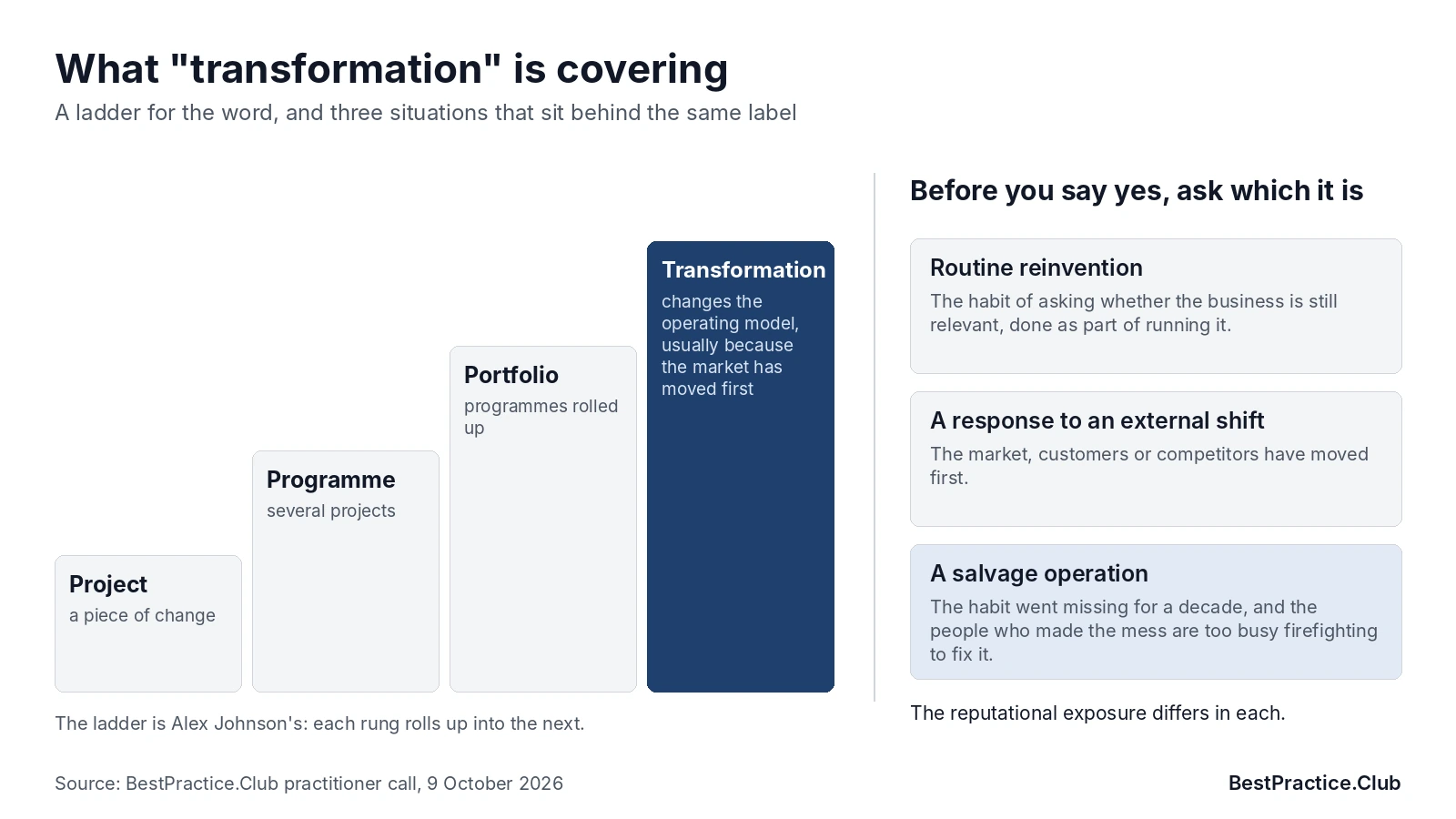
Alex offered a ladder (shown in the image above): a project is a piece of change, several projects make a programme, programmes roll up into a portfolio, and a transformation proper changes the operating model, usually because the market has moved first. His example was a business whose customers had stopped wanting what its network was built to deliver, so the way a working day was done had to be rebuilt around what they wanted instead. Chris pointed out that any business that has lasted decades has done something similar, slowly, over several periods, which makes the stark cases look rarer than they are. Martin dislikes the word altogether.
"Transformative thinking is just good management and everyone should be doing it on a daily basis anyway."
- Martin Mikiewicz, formerly Chief Operating Officer, Blue Phoenix
For him it is the kind of habit a leadership team can build into a monthly agenda by asking whether the business is still relevant, what competitors and customers are doing, and what is about to make today's product obsolete. In his experience programmes carrying the label are often salvage operations in businesses that went without that habit for a decade, where the people who created the mess are too busy firefighting to be expected to fix it.
For the person deciding whether to say yes, the label hides a question worth asking first: whether this is routine reinvention, a response to an external shift, or a salvage operation. The reputational exposure differs in each, and the third is where the over-promising described below does most damage.
Nobody teaches this
What struck me more was how they described learning the work. Chris was four months out of university when he found himself implementing an ERP and MRP system in a food factory that never stopped, working with a charge hand who suddenly had to count and reconcile stock. Nobody had taught him how, or his manager, or his manager's manager. "You're not taught change," he said, and Martin cut in with "We are winging it." Chris picked the phrase up and finished the thought.
"We are winging it and we learn and the best of us learn and … gather those experiences and those toolkits in our kit bag … And it gets leaner because we chuck out what didn't work and we hopefully replace it with what does work and you get better at it and then you can coach others."
- Chris Bassano, formerly of BMI / Standard Industries
The test of having a kit bag, in his view, is being able to coach others. He was equally direct that there is "no magic formula", only the question of how to remix the ingredients for a better result next time.
Martin traced the methods that have passed through businesses over the years, from plan-do-check-act to world class manufacturing, Lean, Six Sigma, Scrum and now AI, and argued that the choice between them matters less than people assume. Like exercise, whichever one you stick with probably works, provided you have first answered the defining questions. What do our customers want from us? Are we delivering exactly that? Do our people understand it, and does our measurement system reflect it, or do we track a few hundred things nobody cares about? He finds it astounding how common it is for a business to lack a definition of what good looks like, and said he gets blown away when he asks some operators whether today was a good day or a bad one.
The day job and the programme
Jon raised the tension that probably decides how many people say yes. Someone mobilising change at pace is usually still accountable for the daily EBIT and OTIF of the area, and that is where people start to feel overwhelmed. He pointed to the banks, which keep dedicated transformation delivery teams, full time and separate from the line, and said the separation seems to take away much of the uncertainty about what the day job now is. Martin described a variation he has seen work, the internal consulting group, which supports a business owner who keeps accountability for the improvement, in place of outsiders arriving to take control. He is wary of a head of business excellence role for a related reason: it makes one person responsible for something everyone has to do, and the silo it creates is often the first thing cut when times get tough. Chris took the opposite route and kept the work with operating leaders, creating the bandwidth within the leadership team so that the day to day and the longer-term work were delivered together.
"I've delivered the day to day and I've delivered the strategic imperatives and I won't use the word transformation, they are strategic imperatives that lead you to a new destination over a multi year period."
- Chris Bassano, formerly of BMI / Standard Industries
That sits next to the finding in our own 2025 survey, where lack of bandwidth was the reason cited most often for innovation, improvement and transformation initiatives failing to progress. Martin only partly accepts it. When he took over a business unit he noticed reports arriving that he had not asked for, collected every recurring one over a month and went through them page by page with the people who produced them, asking who each was for. Nobody read them, and scrapping them freed time for setting targets. He expects the larger the corporate, and the more AI is used to produce output, the more hidden work of this kind there is to find.

Where the career case is actually made
If the label is common currency and the skill is learned by winging it, what separates the careers that benefit? The group kept returning to the conversation before a programme starts. Martin's practice is never to present a figure the business does not already believe. He works through the P&L with the CFO or the problem owner, asking, say, what 40% downtime is worth, what a ten per cent reduction would take (training, equipment, scheduling, raw materials), and whether the electricity bill is out of line with the industry, until there is a target finance can sign off and a timeline of six, twelve, eighteen or twenty-four months agreed with the people who will be held to it. A number with visible mechanics and the finance owner's agreement is hard to dismiss as invented, he said, and he added that it does not always work. Chris described asking his own CFO for the same kind of clarity.
"What are you trying to achieve in the three to five year horizon? Describe that to me financially and now describe that to me non financially because what's it going to look like?"
- Chris Bassano, formerly of BMI / Standard Industries
Those answers, he said, are tangible things a team can organise around to deliver the financial benefit.
I asked what this means for someone managing from the middle, who may have no seat where operating model direction is set and cannot assume the plan above them exists. Alex's answer was that the project itself will surface what the plan lacks, and that the career value lies in how you carry it upward: breaking the findings into pieces a line manager can take to their own leader, in a narrative that makes leadership sit up without undermining it, so that you are seen as part of the solution. People who do this, he said, tend to find themselves moving around the organisation because of the trust it earns.
All of this meets the dilemma I raised towards the end of the call.
"If you don't over promise, you don't get the job."
- Martin Mikiewicz, formerly Chief Operating Officer, Blue Phoenix
The number that wins the mandate is the one you are held to afterwards. When I asked whether any of them had found an answer, Chris said, "I guarantee there is no answer to that one," and Martin added that whoever did would be worth a lot of money. What they described instead was agreeing the drivers, the mechanism and the timeline with finance, in place of committing to a black box.
How much does the business want it?
Whether the career case holds depends on something the person weighing it cannot control, which is how much the business wants the change it is asking for. At our April meeting I put a version of this to the opening panel on operating models: if the board does not feel the need, is there any way to influence upwards, and are there red flags that say it is time to find somewhere that will? Chris and Alex were both on that panel. Neither answered the question in those terms, and what they said about how they got going was more useful than an answer would have been, because it shows what a business that wants the change gives someone, and how long it takes.
Chris spent around a year on the design before he took it anywhere.
"It took me probably 12 months to make the plan to start and design the transformation."
- Chris Bassano, formerly of BMI / Standard Industries
He then presented it twice to the CEO and COO, who told him to go, and from then on he was on the extended leadership team's agenda twice a month: "presenting and educating. What I meant by a supply chain transformation, what I meant by an S&OP process." He even used the coach the CEO had brought in to explain to the CEO what a demand planner was. The first approval was for five demand planners in the key countries, "just to start", which he described as "the first little snowball building momentum". He was candid that the access came with a forcing condition: "If Covid hadn't happened, I wouldn't have got that." The business case begins before anyone opens the template, and Chris's year of groundwork is a good example of it. It is also a recurring theme in the conversations BestPractice.Club records.
Alex's route started from trust. "When I joined Clinigen, I had the opportunity because I had the trust from the CEO," he said, and used it to set up a programme aimed at the people one level below the senior leadership team, on the view that much of the business is actually run there and that some of them have better ideas than the leadership does. He also said what he thinks a working transformation does for the people inside it.
"When you get growth in a business, people can rise and become stars. They get the promotion opportunities because they've got the cash flow."
- Alex Johnson, formerly Chief Supply Chain and Business Transformation Officer, Clinigen
Taken together, my reading is that neither of them describes persuading an unwilling business. Each had a sponsor who gave the idea airtime, a reason for it to matter at that moment, and a business in a position to reward the people who delivered. If none of those is present, whether to wait, build the support first or look elsewhere is the real decision, and it is better made before saying yes than after.
Who is putting their hand up
The live example was AI. Alex described chief executives telling every function to run an AI transformation, with programmes landing on organisations that have no reviewed operating model and unclear data and KPIs. Martin said companies are already asking what they are getting out of it.
"You throw AI onto a mess, you get an invisible mess."
- Martin Mikiewicz, formerly Chief Operating Officer, Blue Phoenix
Alex argued that some of the people volunteering to lead these programmes are the wrong people at a senior level, while the subject-matter experts who understand the operation hold back, put off by the impression that transformation belongs to people with particular qualifications. His advice to them was to take it on, for the network and the confidence it builds.
Jon noted how often an urgent brief ("we need them here in January") comes from a business that seems to have known about the problem months earlier, and the question running through his head is whether they knew six months ago. Chris's answer was "No, it hasn't got a plan," and for him it "all comes back to having clarity of the vision and clarity of the plan." He described the same thing from the other side: a search runs to its final stage and the client puts the decision off or changes the spec, because the role was never budgeted, along with the value it was meant to create, and the business cannot afford the hire. Martin offered a less comfortable explanation, that the person hired may end up as the scapegoat if it fails, which is the circumstance in which the hero or zero stakes are real.
What I take from it
My own read is that the career value sits in the early conversation about target, mechanism and who has agreed to both, and that the skill is learnable, mostly through doing it and through the network that doing it builds. It is also a large part of what happens in the decision gap, and the part most business cases skip. The exposure depends on which of the three situations you are in, on whether the programme was in anyone's plan before it became urgent, on whether finance has agreed what the numbers rest on, and on whether anyone with decision rights wants the change enough to give it airtime.
A practical consequence follows, and again it is my reading rather than theirs. If the label is already expected on a CV, what distinguishes one claim from another is the detail behind it: how the target was set, who agreed it, and who owned the benefits afterwards. That detail can be built before a programme arrives on your desk.
Questions worth asking before you say yes
- Is this routine reinvention, a response to an external shift, or a salvage operation, and does everyone involved describe it the same way?
- What target would your CFO sign off, and who built the calculation behind it?
- Who with decision rights will give this airtime before it starts, and what is making it urgent for them now?
- What was the plan for this role or programme six months ago, and why is it urgent now?
- Who owns the benefits after go-live, and how will anyone know whether they arrived?
- What will you stop doing to create the time this needs, and is delivery on top of your day job or in a separate team?
- If it works, is this a business in a position to promote the people who delivered it?
- If someone asked whether today was a good day or a bad one in the area you would lead, what would you point to?
- Who has led something like this in a comparable business, and what would they do differently?
If you are weighing whether to put your name to a change programme, the Build confidence Pattern sets out where the evidence points and what tends to help.