You sign up to webinars, read white papers, attend events and look at a few solutions — but you still have doubts about championing the capability investment project you feel is needed. You're not alone.
These kinds of decisions not only carry financial risk but also professional risk, with the credibility you invest in them.
The go-live is where success or failure becomes visible but it's what happens — or more precisely, what often doesn't happen — in the decision gap between "this could be better" and "we're ready to commit" that mostly determines the outcome.
Beyond free vendor-driven content and analyst reports but before committing to a full consulting engagement or RFP, BestPractice.Club guides supply chain leaders across the decision gap through structured peer support to test their diagnosis and build confidence before putting their name to a business case.
These are some of the most common patterns we see. A pattern is a distillation of many real examples of how specific supply chain decision challenges tend to unfold... what goes wrong, what tends to work, and what the people who have navigated it say they would do differently. Do you recognise any of them?
At each stage of the decision gap, the question an honest outside perspective asks is different.
ORIENT
Is this the right project, or are we solving the presenting problem rather than the real one?
TEST ASSUMPTIONS
Is our read of the capability gap accurate, or are we about to solve the wrong problem confidently?
BUILD CONFIDENCE
Have we genuinely aligned on the direction, or just avoided the difficult conversations?
COMMIT AND SELECT
Would this plan survive scrutiny from people with no commercial interest in the answer?
The meta pattern described as the decision gap is consolidated from many recorded conversations with supply chain and operations leaders - around eighty percent of them practitioners - over the last 5+ years. The work of making these insights genuinely context-sensitive is ongoing, but the pattern itself is consistent enough that we are confident to share it.
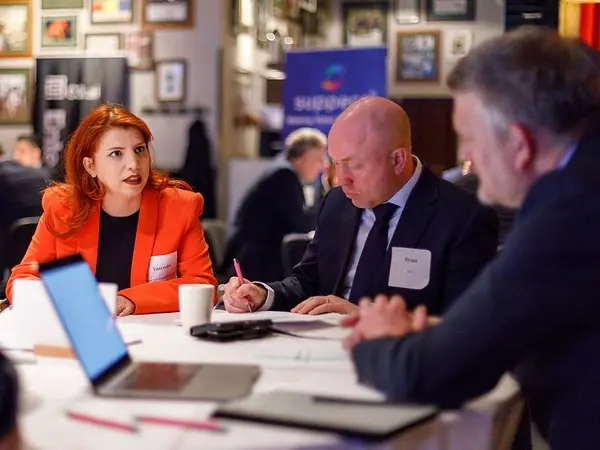
A structured environment where senior supply chain practitioners work through the decision gap for real capability decisions — moving from early orientation through to active peer validation and, ultimately, commitment with confidence.
The ecosystem is designed as a progression. Each format serves a different stage of the decision gap, and the intention is that you move through them naturally as your decision develops.
Signals is often the starting point. A live, curated news feed drawing on multiple sources and organised by topic — resilience, AI, automation, data integration, network strategy, change management and more — it gives an at-a-glance picture of who is doing what and how technology is being applied.
Perspectives go deeper. Longer-form insights from practitioners who have led comparable change projects, consultants and solution providers sharing pattern recognition from their work across many organisations, and anonymised outputs from BPC online sessions. Organised by decision stage, capability area and organisational maturity, this is the first place to compare, contrast and informally benchmark without direct contact.
Patterns takes that further. Where the corpus has accumulated enough practitioner evidence around a specific decision challenge, it surfaces as a Pattern — a consolidated body of insight from organisations that have faced the same decision in comparable contexts. Not generic guidance, and not a framework invented for the purpose. A distillation of what actually happens, what tends to go wrong, and what conditions tend to produce better outcomes, derived directly from recorded practitioner experience.
Online sessions are where passive learning becomes active participation. Practitioner-only sessions explore challenges without commercial influence. Hosted sessions bring in sponsors — not to pitch, but to contribute pattern recognition from working across many organisations — keeping participation free while direction is still forming.
In-person meetings combine panels, roundtables and structured one-to-one meetings in a single day. Panels set the strategic and operational context for the decisions practitioners are navigating, bringing in external perspectives to frame what is at stake and what conditions tend to shape outcomes. Roundtables go deeper, structured around specific capability areas, where small groups of practitioners compare approaches, surface assumptions and stress-test their thinking directly with peers facing comparable decisions. One-to-one meetings are matched individually through the pre-event intake process to ensure genuine relevance and interest, rather than being a condition of entry.
The middle stages are in development but will be deliberately vendor-free. As a direction becomes clearer and concrete plans start taking shape, misaligned assumptions most easily get baked in — sometimes only surfacing long after implementation. That is precisely the moment where independent peer scrutiny matters most and commercial influence matters least.
Once a plan is clear and ready to commit to, solution providers return to test the plan against commercial reality and to surface options that might not otherwise have been considered. By then, practitioners are in a position to evaluate what they are being offered on their own terms.
BestPractice.Club does not tell you what to choose. It creates the conditions for you to choose well.
We work primarily with supply chain leaders at organisations where complexity has outpaced internal capability to navigate transformation decisions alone, typically organisations with revenues between £200m and several billion, though this isn't a hard rule and there are exceptions on both sides.
We're for leaders who are approaching a real decision and want to make it well, not rush to a solution or outsource the thinking.
You’re likely in the right place if:
BestPractice.Club is not a fit if you’re already clear on what you want to use or are looking for lists of options.
You’ll likely be better served elsewhere if:
BestPractice.Club is free to engage with at the early stages but it is not casual.
Before you start, it’s important to be clear about what participation really involves.
There is no fee to:
You will never be asked to pay simply to access ideas, insights, or early peer discussion.
Participation does come with expectations:
As decisions move into building confidence and commit & select — where teams want deeper peer input, more structured support, or sustained engagement — some elements may be offered on a paid basis.
This reflects a shift in depth, not access:
Many sessions are practitioner-only. Others are hosted by solution providers, in formats designed to support decision-making rather than selling — including case studies, structured challenge exploration, and group demos where practitioners collectively examine a specific approach.
Providers are involved because they bring a cross-industry perspective from working across many organisations and contexts - and because better-prepared practitioners make better clients, with clearer requirements, shorter sales cycles, and fewer late-stage surprises.
Solution provider engagement is: