
After many years in senior supply-chain leadership roles across global organisations — including over a decade at The LEGO Group — Cameron Roberts has had the opportunity to reflect on what enables transformation efforts to deliver sustained value rather than temporary momentum.
Across multiple programmes, regions, and operating models, his experience points to a consistent theme: outcomes are shaped less by any individual component of a transformation, and more by how decisions are framed, aligned, and integrated over time.
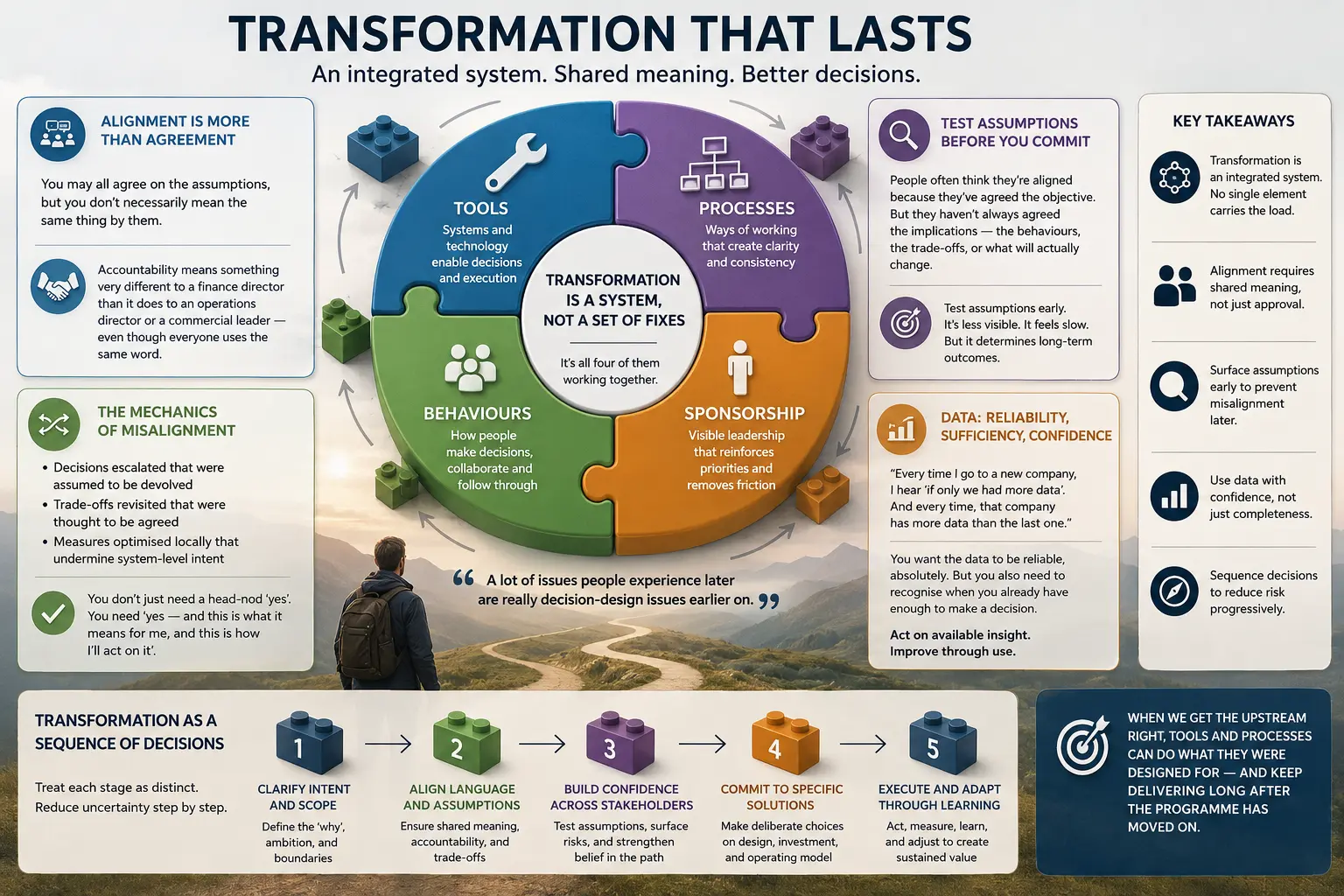
Transformation as an integrated system, not a set of fixes
Looking back across transformations that progressed well and those that proved harder to sustain, Cameron resists single-cause explanations.
“It’s never the tool. It’s never the process. It’s never buy-in on its own. It’s all four of them — tools, processes, behaviours, and sponsorship — working together.”
This observation is grounded in experience rather than theory. In practice, organisations often invest heavily in one dimension while assuming others will follow. A new planning system is introduced with the expectation that behaviours will adapt. A process is redesigned in the hope that tools will catch up. Executive support is secured without resolving how decisions will actually be made day to day.
Where transformation holds, these elements reinforce each other. Where it does not, one element is implicitly asked to compensate for gaps elsewhere — a burden it rarely carries for long.
Alignment is more than agreement
A recurring pattern Cameron has observed is that teams often believe they are aligned because they have reached agreement — approvals have been given, governance bodies have signed off, and plans have been endorsed.
Yet alignment at this level can mask significant differences in interpretation.
“You may all agree on the assumptions, but you don’t necessarily mean the same thing by them.”
This is particularly evident with concepts that sound straightforward but are operationally loaded. Terms such as accountability, service level, or ownership are used across functions, but they often imply different responsibilities, risks, and trade-offs depending on perspective.
“Accountability means something very different to a finance director than it does to an operations director or a commercial leader — even though everyone uses the same word.”
When these differences remain implicit, programmes can still move forward. However, they tend to rely on continued senior intervention to maintain coherence. Once that pressure reduces, teams revert to interpretations that make sense locally, and fragmentation reappears.
The mechanics of misalignment
What makes this challenging is that misalignment rarely presents itself explicitly at the outset. Instead, it surfaces gradually through behaviour.
Decisions are escalated that were assumed to be devolved.
Trade-offs are revisited that were thought to be agreed.
Measures are optimised locally in ways that undermine system-level intent.
From Cameron’s perspective, these are not failures of intent or competence. They are signals that shared understanding was never fully established.
“You don’t just need a head-nod ‘yes’. You need ‘yes — and this is what it means for me, and this is how I’ll act on it’.”
The under-invested stage: testing assumptions
Many transformation journeys move quickly from ambition to execution. Cameron’s experience suggests that an intermediate stage — deliberately testing assumptions — is where long-term outcomes are often determined.
This work is less visible than system implementation or process redesign, and it can feel slow. It involves surfacing differences in interpretation, risk appetite, and expectations before formal commitments are made.
Yet skipping this stage does not eliminate disagreement; it merely postpones it.
“People often think they’re aligned because they’ve agreed the objective. But they haven’t always agreed the implications — the behaviours, the trade-offs, or what will actually change.”
Where assumptions are explored explicitly, later stages tend to progress with fewer surprises. Where they are not, programmes may advance quickly at first, only to slow as unresolved differences re-emerge under pressure.
Data: reliability, sufficiency, and confidence
Another area where Cameron’s experience adds nuance is data. Across organisations, he repeatedly encountered strong aspirations for better data quality and greater reliability.
Often, this was framed as a prerequisite for action.
“Every time I go to a new company, I hear ‘if only we had more data’. And every time, that company has more data than the last one.”
In practice, the constraint was rarely availability. It was confidence — confidence in what the data represented, and confidence in using it to inform decisions.
Cameron distinguishes between reliability and sufficiency. Reliable data matters. But waiting for completeness before acting can become a form of risk avoidance.
“You want the data to be reliable, absolutely. But you also need to recognise when you already have enough to make a decision.”
In the transformations that progressed most effectively, teams acted on available insight while continuing to improve data quality through use. Action and learning reinforced each other, rather than being treated as sequential stages.
Transformation as a sequence of decisions
One of the clearest patterns Cameron identifies is the importance of sequencing. Transformations that endure tend to unfold as a series of deliberate decisions, each addressing a different type of uncertainty.
Typically, this involves:
- clarifying intent and scope
- aligning language and assumptions
- building confidence across stakeholders
- committing to specific solutions
clarifying intent and scope
aligning language and assumptions
building confidence across stakeholders
committing to specific solutions
Compressing these stages can create the appearance of speed, but often increases downstream friction. Treating them as distinct allows risk to be reduced progressively rather than concentrated in a single commitment.
“A lot of issues people experience later are really decision-design issues earlier on.”
A practical reflection
What emerges from Cameron’s reflections is not a prescription, but a way of seeing transformation differently.
Rather than asking which system, process, or methodology will deliver results, his experience suggests starting with how meaning is shared, how assumptions are surfaced, and how decisions are sequenced.
When sufficient attention is given to these upstream elements, tools and processes are better able to do what they were designed for — and to continue doing so after the programme itself has moved on.