Navigating the Decision Gap in Supply Chain Capability Investment
"The Making the Case and Committing chapter alone is worth downloading the guide for. We're not natural salespeople in this world, so being able to sell the upsides is invaluable... structuring the business case, reading the room, and deciding how you communicate the programme."
- Matthew Spencer-Skeen, Senior Global Demand Planning and S&OP Lead, Tech Ops, Mundipharma
A very well written piece, capturing practical insights from the Best Practice Club group and resonates strongly with my personal experience leading digital transformation programmes. The point that stakeholder alignment is often a greater risk than the technology itself is particularly insightful and reflects many of the lessons we continue to see delivering high value, large-scale digital transformations.
- Brian McConville, Global Transformation Leader, BAT
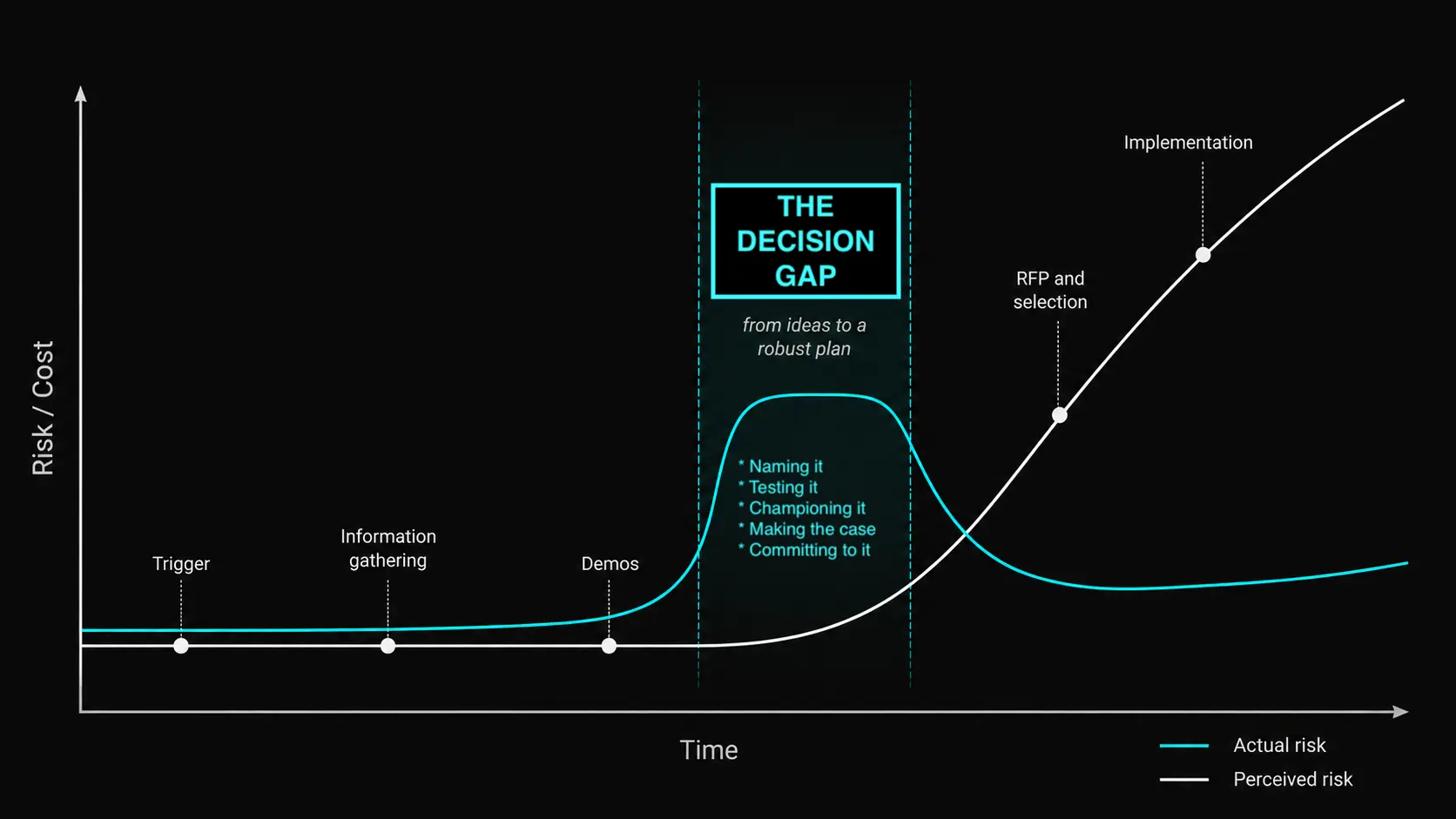
Most capability investments that get stuck don't get stuck because the business case was weak. They struggle in the stretch before a business case exists at all: the period between first sensing that something needs to change and the point where an organisation is ready to commit. That stretch has no name on the organisation chart, no budget line and no obvious owner, which is exactly why it gets skipped, rushed, or handed prematurely to whoever offers the clearest answer. We call it the decision gap.
Most of what determines whether a capability investment is ever approved - and whether it ultimately succeeds - is decided there, before anyone would say the project has started.
Most investment decision-makers who receive a supply chain capability business case have not been through the journey that produced it. They have not seen the diagnostic work, the architecture options that were considered and rejected, or the organisational conditions that will determine whether the investment delivers.
This was written for supply chain, operations and transformation leaders who are somewhere in that gap now: sensing that something needs to change, testing whether their read of it is right, or building the case to put their name to it. If a live capability decision is somewhere on your desk this year, in whatever form, it should feel like it was written with your specific situation in the room.
It wasn't written for people evaluating vendor sales techniques, or for a general management audience with no live decision in front of them. Both may find the patterns interesting from a distance, but distance isn't what the guide was built for.
For most of the last decade, BestPractice.Club has hosted and recorded conversations among senior supply chain leaders working through real capability investment decisions, under the Chatham House Rule.
This guide is what those conversations have taught us about the decision gap so far: the patterns that repeat across organisations, sectors and contexts, not opinion or theory. It exists because the available help stops in the wrong place. Analysts map markets. Consultants arrive once a direction is set. Solution providers engage once there's something to sell to.
The stretch in between, where the outcome is actually decided, is where leaders are most often on their own.
The guide maps the decision gap in five stages, following the journey as it's actually experienced rather than as a project plan describes it.
Naming it — something needs to change, the hard part is knowing exactly what.
Testing it — you have a diagnosis, tested so far only by people who agree with you.
Championing it — you believe in the direction, the hard part is deciding whether to put your name to it.
Making the case — the direction is right, the hard part is a case that survives contact with finance.
Committing to it — you're committing, and most of what decides the outcome has already been set.
Each section works through the patterns behind that stage: what tends to happen, where it tends to go wrong, and what practitioners who've been through it say they'd do differently, closing with questions built to be asked by you, of you, and of the room around you.
Reading it is a way of testing your own thinking against people who've been through the same decision before you, with nothing to sell you along the way.
