
One objection comes up in almost every conversation about AI in supply chain planning: nothing useful can happen until the data is right. At a BestPractice.Club panel on build versus buy, held under the Chatham House Rule, it was put forcefully in the first few minutes. Later in the same session another panellist described a $100 experiment that appeared to contradict it. The two accounts turned out to fit together, and what they say about where the real difficulty now sits is worth setting out.
The objection is a reasonable one
Asked to raise a hand if they had 95 to 97 per cent confidence in their master data, a room of senior supply chain and planning people produced a single hand. The panellist asking made the case plainly: AI compounds the problems it meets, and going live without ownership, process and governance produces "automated chaos". Gartner's version of the argument is a prediction that, through 2026, organisations will abandon 60 per cent of AI projects unsupported by AI-ready data. The caution is earned, and it recurs across the conversations we record.
The $100 experiment
Another panellist described a logistics cockpit built with an AI coding assistant for about $100 in credits. Its inputs were disparate extracts pulled into Excel, and its semantic layer was "literally just what the business put into the Excel". It surfaced a possible saving of around $200,000 a year from shipping direct from factories to certain countries. Reaching the same answer through the company's data lake, with its models and normalisation, was estimated at eighteen months.
The cockpit is used by one person and has not been productionised, and the saving remains a hypothesis until someone accountable has checked it. That detail does most of the work in reconciling the two accounts. An analysis that a person reviews before anything happens can tolerate data that an automated action cannot, which is why one panellist's preferred sequence started with analysis, moved to recommendations that a human agrees or rejects, and left integration and automation until much later. "You don't start with automation," as one panellist put it. The question that sorts the two positions is one BestPractice.Club keeps returning to: good enough for what decision?
Cheap experiments move the difficulty
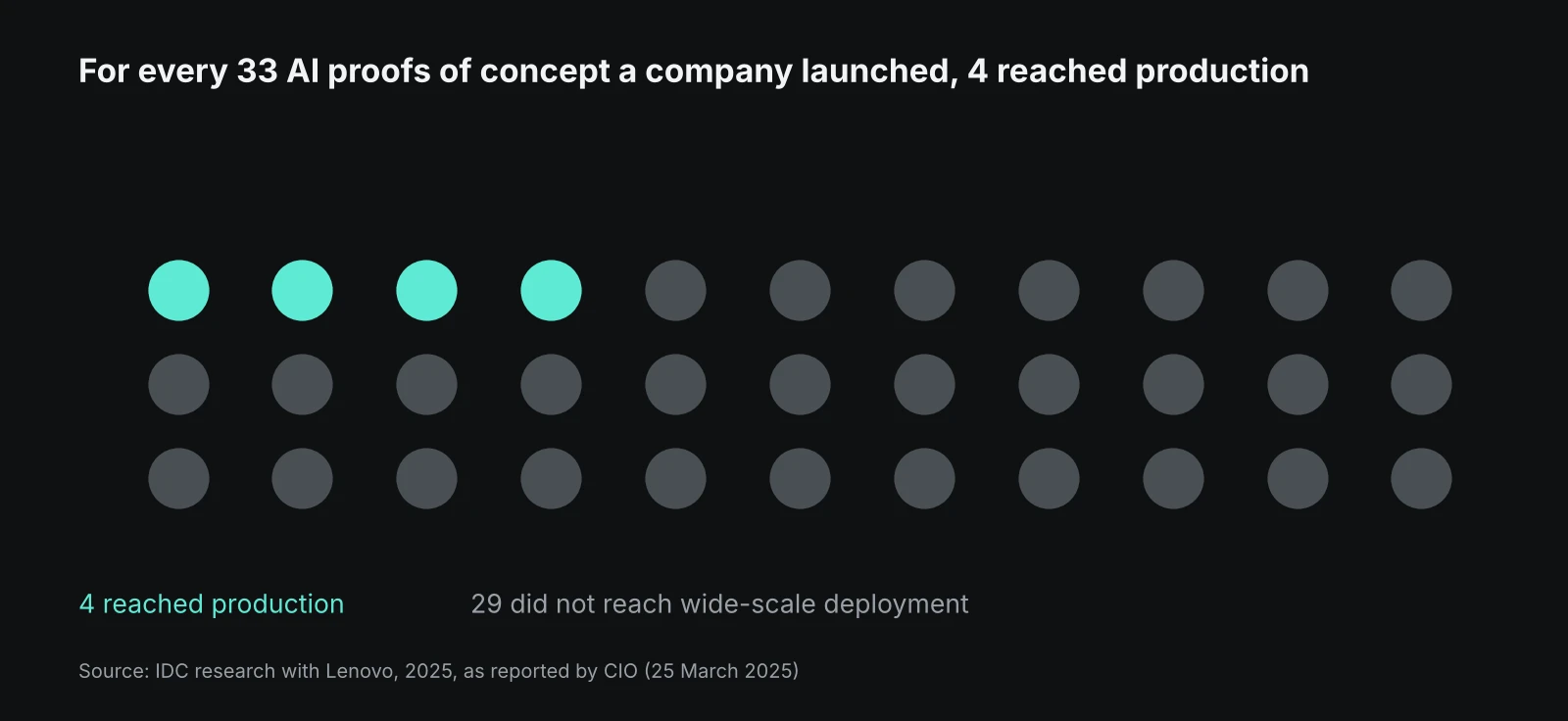
If proving a point now costs an afternoon, proof stops being the scarce thing. Panellists described the new situation in similar terms: every day someone produces another dashboard, and the work has become "picking a lane for a capability", then putting in the access, permissions and training to deploy it to thousands of people rather than the ten who have seen the demo. IDC research with Lenovo found that for every 33 AI proofs of concept a company launched, four reached production, and its authors read that as a sign of low organisational readiness in data, processes and infrastructure. Cheaper proofs seem likely to increase the number launched without increasing the number that graduate, because the reasons for stalling sit after the proof.
One panellist described a version of this that leaks around the governed route. People extract data from the planning system, hand it to a general-purpose assistant and ask it to run the plan, because the sanctioned route is not arriving quickly enough. The organisation's own platform strategy has to move at the speed of the workarounds, and the workarounds are accumulating technical debt in the meantime.
Who pays when it scales
Commitment brings costs that experimentation did not. The approaches described included usage caps per user, with higher caps for power users and champions, training so that credits are not burned inefficiently, and a capped budget for proof of value. Beyond that point the business funds what it wants to scale and commits to savings against the P&L. One panellist noted that boards ask for actual numbers, and that a thousand hours saved in a team is not necessarily a cost saving. Pricing adds uncertainty of its own: fixed-price offers feel safer until renegotiation moves them to credits, and one vendor was reported to want a million in minimum commitment before proving any value.
Scale of business changes the arithmetic. Someone in the room pointed out that a $20 billion company can afford to hire and experiment, while a company of $300 million to $400 million has a different decision to make with the same tools.
Where the panel did not agree
On architecture the views split three ways. One favoured the connectivity and cross-chain simulation of an end-to-end planning platform, accepting integration points at the edges. Another expected specialised, interoperable tools to displace large packages altogether. A third described a data lake and orchestration layer around the ERP core, moving from analytics to recommendations to integrated execution, with the aim of becoming AI native, which in that view cannot be reached by buying embedded features alone. Each position rests on what the organisation wants to become, which no panel can settle for it.
What this says about the decision gap
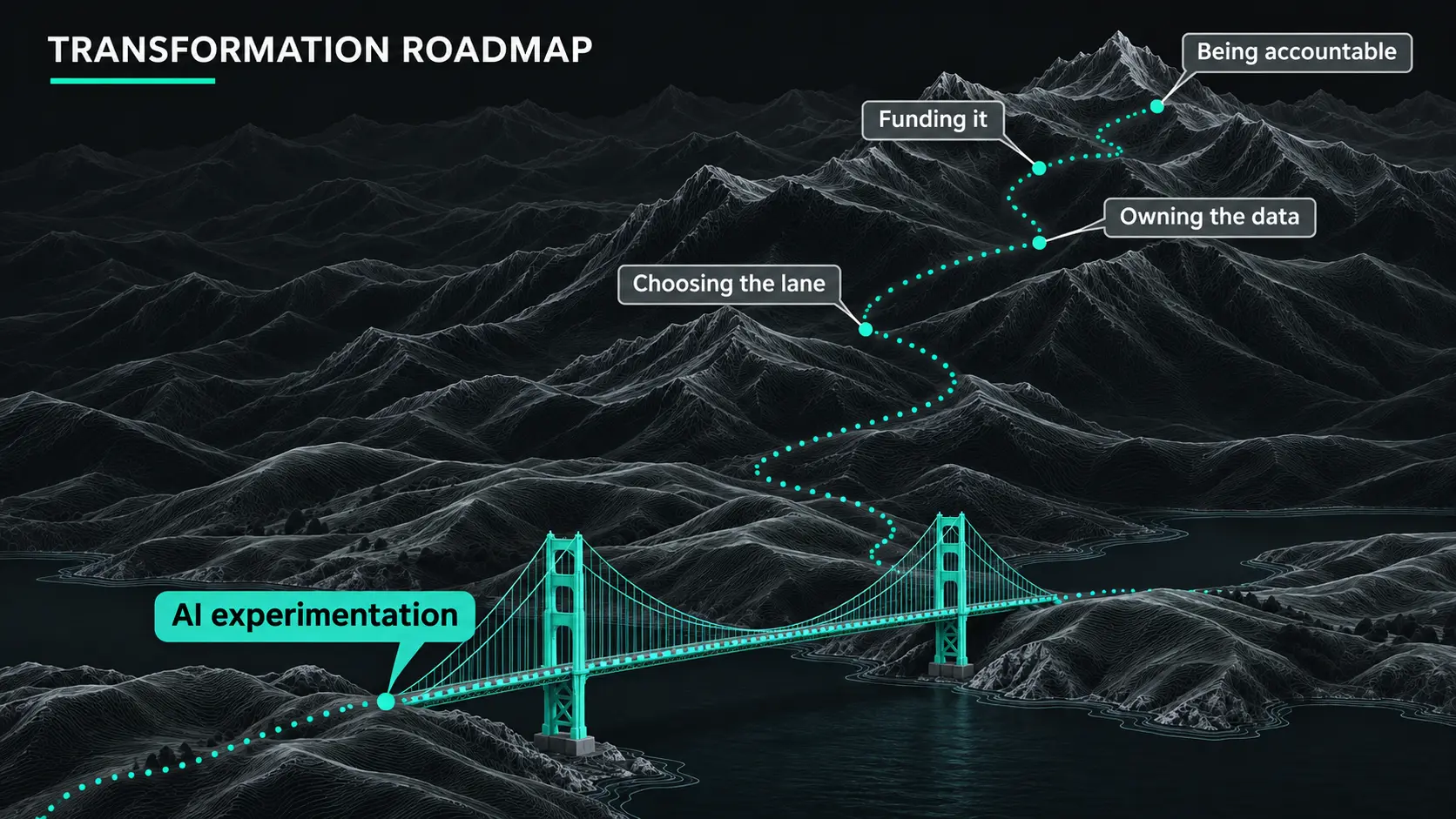
Across the conversations we record, capability programmes tend to stall in the stretch between recognising that something needs to change and committing to act, which is the decision gap. This panel suggests that cheap experimentation has shortened the first half of that stretch and left the second where it was. Someone still has to choose the lane, own the data it depends on, fund it against a number and be accountable when the output is wrong.
Questions to take back
Which decision would this data have to support, and does a person check the output before anything happens? An analysis someone reviews can run on imperfect data. An automated action needs far more confidence in the data underneath it.
If the experiment works, who funds the lane, and against which line of the P&L? Proof of value on a capped budget tends to end at the point where a business owner has to commit savings.
What are people already doing with extracts of governed data while the sanctioned route catches up? The answer shows where the organisation's own platform strategy is running behind its workarounds.
If a decision like this is live for you, the AI in planning pattern sets out how comparable organisations have approached it.
This piece draws on a BestPractice.Club panel held on 20 November 2026 under the Chatham House Rule, and on earlier sessions in the corpus. Remarks are deliberately not attributed to individuals. Thanks to Andrew Gilliver, Nick Miles and Daniel Mielke for joining the panel.