
Participants in a recent practitioner discussion described a process that works in the regions and struggles when someone tries to make it global. Most of what they called a people problem turned out to be a question of who is allowed to ask whom to change.
We recently ran an online discussion for people who lead S&OP in their organisations, co-hosted with Iter Consulting, a BestPractice.Club partner. It ran under the Chatham House Rule, so participants are not named, apart from those who have agreed to be quoted. The session was framed around the idea that people, rather than process, limit S&OP. What was described over the hour pointed somewhere narrower.
Right bodies, wrong conversations
Nearly everyone had a version of the same situation. One group was moving from three very different regional processes to one that could roll up into a global view, and described the regional versions as effective enough until someone looked closely. Another had a long end-to-end supply chain with demand changes landing in supply forums too late to act on, and a supplier who now served several regions, which no regional meeting was built to handle. A third had attendance under control and engagement nowhere: the right people were in the room, and some were answering messages while the numbers were discussed.
Others had the opposite problem. Senior leaders declined to attend because they would not have the detail to raise a risk. The organisation moved to middle managers, and then found that none of them could decide anything. This comes up repeatedly across the conversations we record, and it points to the same difficulty from two sides: a forum built for reporting cannot become a forum for decisions by changing who sits in it.
What one survey made visible
Hannah Lawlor of Inchcape runs S&OP across a business with three key meetings each month: an early risk review, a meeting to align the plan, and one where purchasing is endorsed. Last year she asked the S&OP leads in every region who actually attended and found that fewer than half of managing and finance directors attended. The results went to the leadership team and attendance became an organisational priority.
Finance and S&OP now set next year’s plan together, starting with only volume and assumptions because those were where the two sets of numbers diverged, with inventory to follow the year after. And each meeting works from a six-box summary that sets out decisions made and decisions required, which she has started to see used by teams she did not introduce it to.
Making the meeting a place where decisions arrive
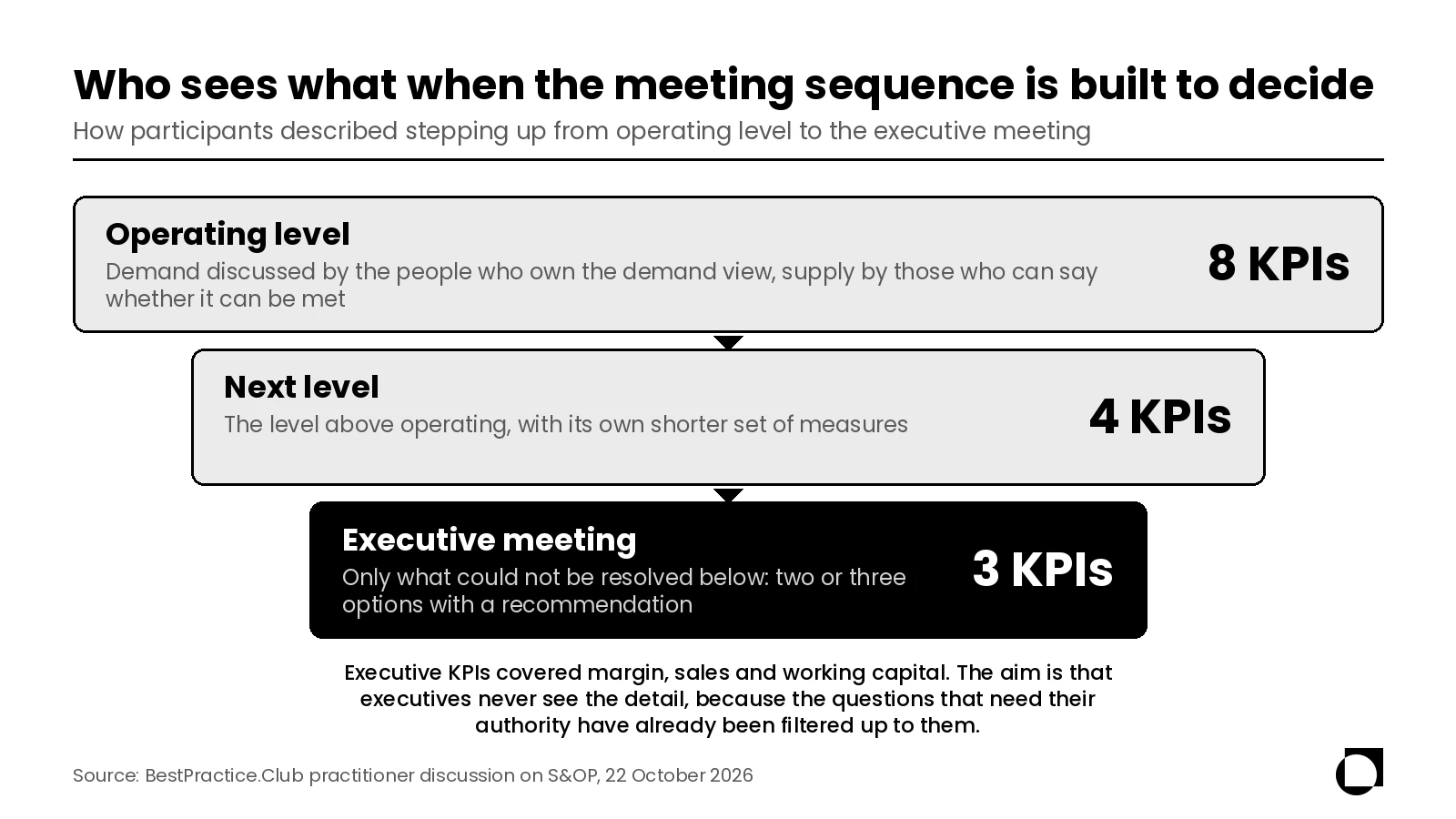
Several participants described separating the sequence by purpose. Demand is discussed by the people who own the demand view, supply by those who can say whether it can be met, and the executive meeting sees only what could not be resolved below it, usually as two or three options with a recommendation. One participant gave the numbers: eight KPIs at the operating level, four at the next, three for the executive group, covering margin, sales and working capital. The aim is that executives never see the detail, because the questions that need their authority have been filtered up to them.
Iter’s Paul Kelly offered a discipline that sits underneath this. Start from the decisions the meeting has to make, then work back to the data it needs and the people who need to be there.
Authority sits above the meeting
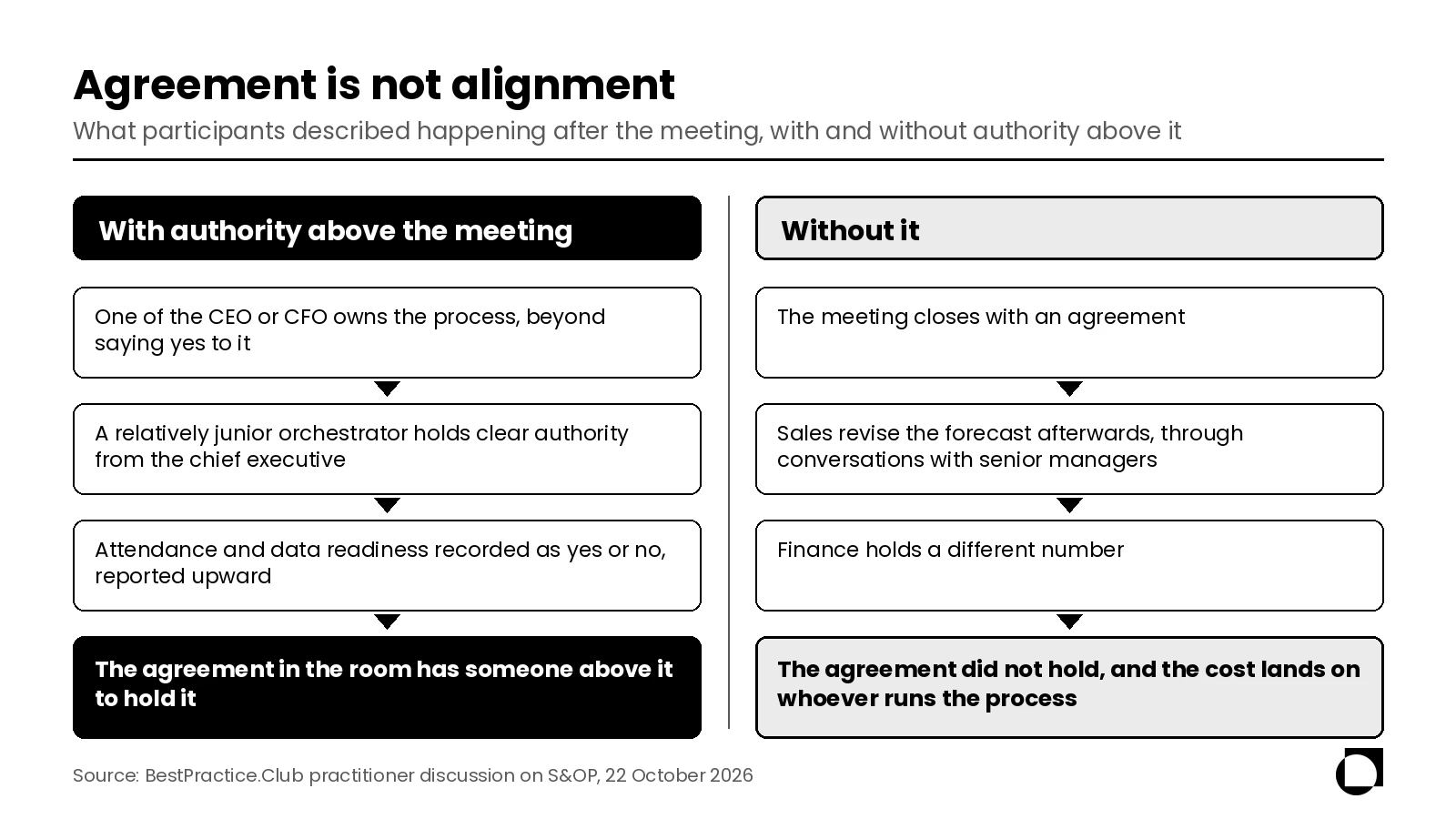
Participants returned repeatedly to the person who owns the process, and the weight that falls on them. One had needed an executive instruction, a three-line whip as they put it, before a new version would be accepted anywhere, because gentler routes had already failed. Another had the advantage of a managing director who set the process up and later became global CEO, so the sponsor moved up with it. Tim from Iter said that one of the CEO or CFO has to own the process in a way that goes beyond saying yes to it, and described a client where a relatively junior orchestrator had clear authority from the chief executive, with attendance and data readiness recorded as yes or no and reported upward.
A pattern emerged around what happens without that authority. Sales revise a forecast after the meeting through conversations with senior managers. Finance holds a different number. The meeting produced an agreement, and the agreement did not hold. Agreement is not alignment, and the cost of the difference lands on whoever runs the process.
Where the decision gap sits here
S&OP is a recurring forum, so it can look unlike the one-off investment decisions BestPractice.Club usually writes about. Yet the decision gap shows up in the same place: the stretch between recognising that the process is not producing decisions and getting someone with authority to commit to behaving differently. Attendance metrics, surveys and standard templates all help, and each of them asks the people with least power to push upward.
A process whose owner cannot change what the executive above them does will produce attendance and reporting for as long as it runs. The first decision an S&OP process needs is usually taken outside the meeting, by whoever sits above it.
Questions practitioners ask
Who needs to be in the meeting? Participants who split demand, supply and executive stages suggested different people at each, with the executive stage confined to unresolved issues and decisions.
How do we get decisions rather than reporting? Work back from the decisions required, and give the forum a summary that makes them explicit before anyone discusses detail.
What if the executives will not come? The conversation moved to who sits above the process and whether they are asked to decide something, which differs from asking them to attend.
If the process you own is producing attendance without decisions, the Stakeholder commitment Pattern sets out the questions practitioners tend to ask about whether agreement in the room is genuine commitment.
Explore the Stakeholder commitment Pattern
The S&OP roundtables at our 12 November London meeting continue this discussion, hosted by Iter Consulting.