

The account that follows comes from a former supply chain and planning transformation lead who led a multi-year planning capability programme at a fast-growth FMCG business, through the years spanning the pandemic and the cost-of-living crisis that followed it. Neither he nor the business is named here. The leadership decisions described belong to people who have mostly since moved on, and his account is offered as evidence of a pattern rather than a complaint about individuals.
It draws on his experience to explore three things: how a business's absence of planning discipline can be masked by growth until an external shock removes the cover, how a business case can collect every appearance of sign-off without the person signing understanding what they have approved, and what it eventually took, a pressure that arrived from outside the organisation rather than from any internal discipline, to make the numbers honest again.
Growth that outran the discipline to manage it
The business had never built planning discipline. It did not need to. Years of strong growth absorbed the gaps that would, in a flatter market, have been impossible to ignore: forecasts that missed, working capital that crept up, a supply chain function that was lean relative to the complexity it was managing. None of this registered as a crisis, because the top line kept covering for it.
Then growth stopped. The pandemic and the cost-of-living crisis that followed did not create the planning problem; they removed the thing that had been paying for it. Household budgets came under sustained pressure through 2022 and into 2023, and demand for the discretionary end of the FMCG shelf softened with them. A business that had never had to distinguish between a forecast it believed and a forecast it hoped for found itself needing to make that distinction under pressure, for the first time, in public.
The credit card mentality
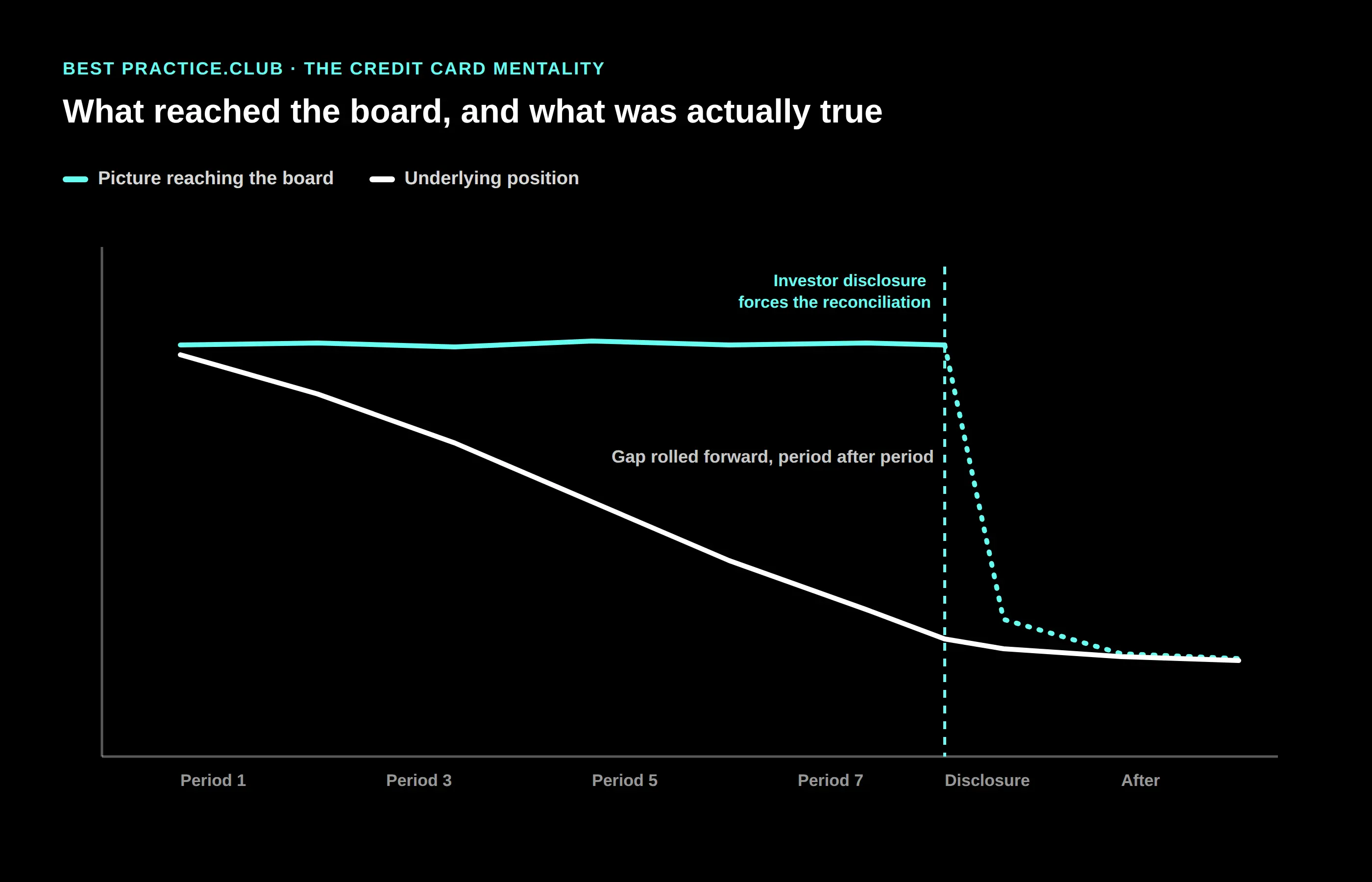
What the transformation lead describes next is not a single failure but an accumulation of small ones. Forecast gaps, month after month, were not closed. They were rolled forward.
"Rolling forecasts" are a standard financial planning tool: a forecast that always extends a set number of periods into the future, updated on a regular cycle. Used honestly, they let a business keep a live view of where it is heading. Used the way this business used them, they became something closer to what the transformation lead calls a "credit card mentality": a shortfall this period becomes an assumption to make up next period, then the period after that, and the management information reaching senior leadership is corrupted a little further each time a gap is deferred rather than named.
No single accommodation looked dishonest. Each one was defensible on its own terms. Part of why the gaps kept travelling upward rather than being raised is a dynamic he puts bluntly: "You're telling the dad or mom of the baby that the baby's ugly and they're not going to like it." Nobody wanted to be the person who said the number was wrong. So the number kept being adjusted instead, and the picture reaching the board stayed green for far longer than the business underneath it actually was.
A black box wrapped in a ribbon
By the time a business case for a proper planning capability reached the CFO, the underlying picture had been smoothed for long enough that the case itself looked clean. KPIs were in range. The return on investment stacked up. And that, in the transformation lead's account, is exactly the problem.
"That black box is wrapped in a ribbon. It looks pretty nice. KPIs look good, return on investment, et cetera. Yeah, I sign it. And that's never the right outcome."
The sign-off happened. What it bought was much thinner than it looked. Research on how major decisions get approved offers a name for part of what was happening here. Bent Flyvbjerg's work on optimism bias and strategic misrepresentation in project approval describes how the figures put in front of a sponsor are systematically more favourable than the figures the delivery team will actually meet, not always through deliberate deception, but because the incentives all point the same way: everyone closer to the case has more to gain from its approval than from its accuracy. A sponsor who signs a business case they do not personally understand is not applying judgement to that case. They are applying trust to the people who built it, and hoping the trust is warranted.
The transformation lead's own diagnosis of what was missing is a governance failure rather than a technology one.
"Governance is your first stepping stone to successfully land a proper planning project. You can have Kinaxis, you can have the best data, you can have whatever you call it in the best practices. And if you don't have the governance to support the planning that you expect to implement, you are set up for failure."
"Most of the change management is all about the people who are down on the ground doing the process. If the governance from the top is not supportive, it's not going to happen."
The case was approved without the person approving it having the vocabulary to interrogate it. That is not a document problem. Improving the deck would not have fixed it.
Agreement that didn't survive contact with go-live
The approval bought the programme a design phase in which everything continued to look settled. Workshops ran, agreements were reached, senior stakeholders nodded along to what the change would require of the business. What it would require of them personally is a different question, and it was not one anyone had really tested.
"You go live and the old behaviors come back. All of the agreements and handshakings were meaningless. We had to experience trial by fire."
"They were not realising that it also meant that they have to change. They had to adapt their behaviors, they had to adapt how they provided guidance to people."
This is a different shape of counterfeit agreement to the one explored in Making Transformation Hold, where the failure runs sideways between functions that agree on the words and mean different things by them. Here it runs upward. The champion did the work correctly with the people who would use the new system day to day. The unresolved agreement sat with the person above him, whose understanding of what he had signed turned out, at go-live, to have been nominal. Agreement is not alignment whichever direction it fails in, but a sponsor's counterfeit yes is more expensive than a peer's, because there is no colleague positioned to catch it before the organisation is committed.
What it took to get real numbers
What eventually broke the pattern was not an internal review, a change of process, or a moment of leadership resolve. It was investors.
As the business's numbers came under the kind of scrutiny that public disclosure obligations impose, the gap between the picture the board had been shown and the picture the market needed could no longer be smoothed by rolling it forward another period. The CFO who had signed the black box began demanding real numbers, not because the governance inside the business had improved, but because the cost of an unreliable forecast had moved from internal to external, from something that could be absorbed quietly to something that could not.
It is a useful and uncomfortable data point about where the real forcing function sat in this case. The internal conditions that should have surfaced the gap, a governance structure that tested what leadership actually understood before it signed, a sponsor equipped to ask what the numbers assumed, were absent throughout. What replaced them was not discipline. It was exposure.
What this means for the person being asked to sign
Read from the sponsor's side rather than the champion's, this account is a fairly specific warning. A business case that looks clean because every KPI is in range and every return figure is favourable is not evidence that the case is sound. It may only be evidence that nobody involved in producing it had an incentive to make it look otherwise.
The business case begins before anyone opens the template, and for the person being asked to approve it, that means the real work happens before the document reaches the desk: understanding what the numbers assume, not just what they conclude; asking what would have to be true for the return to hold, and whether anyone has tested it; and being honest, before signing, about whether "I sign it" reflects genuine understanding or trust extended to people whose incentives are not neutral.
None of that guarantees the case is right. It is the difference between a decision and an approval that happens to look like one.
Questions worth asking
- When a business case reaches you for sign-off, could you explain, in your own words, the two or three assumptions that most determine whether the return materialises?
- Has anyone deliberately tried to make you say no to this case, or has every conversation about it been designed to help you say yes?
- If a forecast has missed for several periods running, do you know whether the gap was closed or carried forward, and who made that call?
- What would it cost the people who built this case to tell you honestly that the underlying picture is worse than the summary suggests?
- If this programme reaches go-live and the behaviours it depends on from you personally do not change, what actually happens?
- Would your organisation only find out the real numbers if an outside party forced the question, or could it find out on its own?
This account is drawn from a single practitioner conversation recorded as part of BestPractice.Club's ongoing programme of practitioner interviews. The organisation is not named, and the practitioner is not named at his request. The events described took place several years ago, and most of the leadership team involved has since left the business.