
A familiar pattern runs through many planning transformation conversations. The presenting symptoms are operational: forecast accuracy is poor, inventory is either too high or too low, functions are pulling in different directions, and S&OP/IBP meetings are consumed by resolving discrepancies rather than making decisions.
The response is usually to look for a planning solution or process improvements.
Chris Turner has spent decades working on planning and strategy with organisations of varying scale and complexity. His observation, consistent across those engagements, is that the operational symptoms are often real, but they are downstream of a more fundamental problem. In many cases, the organisation has not established sufficient clarity about what it is actually trying to achieve.
"Planning is there to choreograph all the actions," he says, "ensuring coherence towards whatever goals the organisation has. The biggest upstream issue I find is that organisations haven't got the clarity they need at that overarching level."
Without that clarity, planning processes tend to optimise locally. Functions pursue their own measures. Short-term urgencies crowd out longer-horizon decisions. And the S&OP or IBP process, designed to create alignment, ends up reconciling incoherent plans and arbitrating between competing departmental positions rather than testing whether the organisation is moving in the right direction.
The strategic gap that S&OP rarely closes
Part of the difficulty is structural. S&OP as a discipline grew from supply-side origins: planning managers looking to coordinate production and inventory against demand. It evolved to encompass more of the business, but it retained that operational centre of gravity. In most organisations, S&OP still focuses primarily on making existing operations run efficiently.
That is valuable. But it means that when the real strategic question is about growth, new products, new channels, geographic expansion, new business models, the process is poorly equipped to answer it. The functions that carry that knowledge and those decisions (R&D, marketing, business development) are typically peripheral to the S&OP forum, if they are present at all.
This is a well-documented structural limitation. Research into IBP maturity consistently finds that fewer than 20% of organisations achieve genuine integration of financial and strategic planning within their S&OP cycle — most remain anchored in operational coordination at the expense of longer-horizon decision-making. (ASCM research on S&OP maturity)
Chris frames this as one of the most consistently underestimated leverage points: the gap between existing-business planning and new-business planning. Many organisations have ambitious growth strategies. Their S&OP process is built to do more of what they already do, efficiently, but the upstream drivers, choices and actions for growth are managed outboard of this process. The two rarely connect.
What a planning leader can actually do
The natural response to this diagnosis is: strategy is above my pay grade. The supply chain or planning director doesn't set organisational direction, they work within it.
Chris's view is that this understates the available options. The starting point does not require authority over strategy. It requires visibility of it.
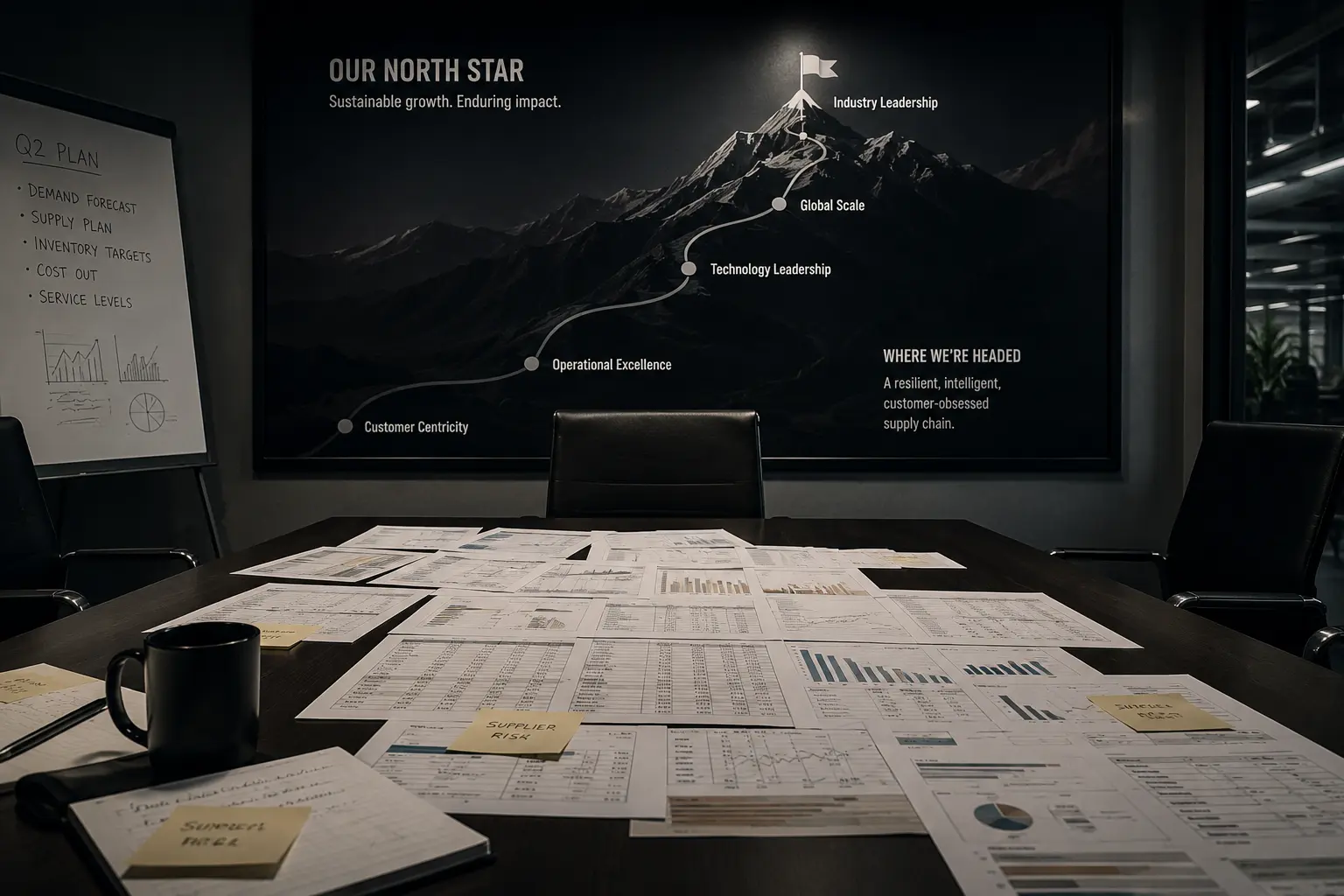
Most organisations have documented objectives somewhere. The first practical step is to bring those objectives into the room. Not to critique them, but to test planning decisions against them. What we often find, he notes, is that when you lay the stated objectives alongside current plans and priorities, incoherence becomes visible fairly quickly. A growth strategy pointing one direction, capital allocation pointing another. Service targets that conflict with cost reduction goals. That exposure itself tends to create energy, and usually surfaces at least one senior figure who has been carrying the same frustration and is ready to engage.
The goal is not to resolve the strategy. It is to start a dialogue that makes the gaps harder to ignore.
Reframing S&OP as a strategy deployment process
The more lasting shift, in Chris's view, is to treat S&OP or IBP not as a coordination process but as a strategy deployment process: the mechanism through which longer-horizon choices are translated into near-term decisions and tested against emerging reality.
This changes what you use the monthly cycle for. Rather than asking only whether supply and demand are aligned, it asks whether the assumptions underpinning the plan still hold. Is the market developing as expected? Are the customers or categories we were counting on materialising? Are the new initiatives on track?
This reframing has grounding in the broader IBP literature. Work by Oliver Wight and others on Class A IBP describes exactly this shift in orientation: from a supply-demand balancing exercise to a mechanism for testing strategic assumptions against operational reality in a regular cadence. (Oliver Wight on Integrated Business Planning)
Using S&OP/IBP to create the connection between strategy development, deployment and delivery has outsized internal benefits for any organisation pursuing a fundamental change, innovation or growth strategy. In the face of increasing external disruption, volatility and uncertainty, it carries an additional premium. The ability to remain aligned and coherently course-correct in response to external change is a fundamental building block for developing organisational resilience and systemic adaptability.
That reframing does not require a separate process or additional meetings. It requires a different set of questions in the room, and a willingness to surface strategic assumptions alongside operational ones.
The bandwidth problem
Many planning and supply chain leaders are already stretched. Running the operation while trying to improve it is genuinely difficult, and the risk of championing a transformation programme that stalls or underdelivers is not abstract. It has career consequences. For many, the rational response is to wait until conditions are clearer.
Chris's view is that waiting for strategy to be fully resolved before making progress is rarely the right call. You can get a long way by improving what you already have, particularly if S&OP is functioning at a basic level and can be extended. But the question of where to focus scarce energy matters.
His frame for this is leverage points: not which problems are most urgent, but which changes would have a disproportionate impact on the whole system. The concept comes from systems thinking, and Donella Meadows' framing of high-leverage interventions is worth revisiting for anyone trying to navigate this: changing the goals of a system, or the rules and information flows that govern it, consistently outperforms optimising individual components. (Donella Meadows, Leverage Points: Places to Intervene in a System)
That might be a governance change, a missing connection between functions, or a reframing of what an existing process is trying to do. Fixing a local problem efficiently is not the same as changing what the organisation is systemically capable of.
For leaders working out where to start, that distinction is probably more useful than any particular methodology or framework.
Chris Turner is Co-Founder of StrataBridge, which works with organisations on the intersection of strategy and planning. This conversation was part of BestPractice.Club's ongoing series of practitioner interviews exploring the upstream decisions that shape whether planning transformation delivers.
BestPractice.Club brings together senior supply chain and planning leaders to peer-review major transformation decisions before committing. Details of upcoming sessions at bestpractice.club/upcoming-sessions.