
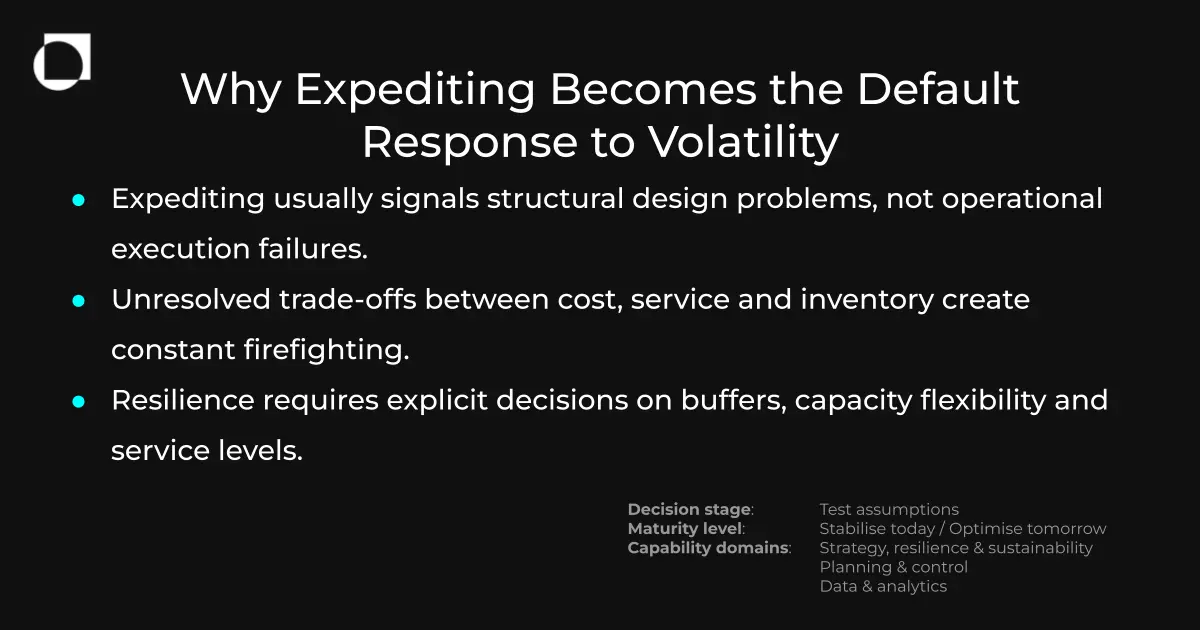
Why Expediting Becomes the Default Response to Supply Chain Volatility
In a recent discussion with a group of supply chain leaders from different industries, one comment captured a pattern that many organisations will recognise. A manufacturing leader described how their factory had historically been planned at around 120% utilisation, on the assumption that operational inefficiencies would bring actual output closer to 100%. The intention was understandable: maximise asset productivity and minimise idle capacity.
The effect, however, was predictable. When anything unexpected occurred (a supplier delay, a demand spike, a quality issue) the system had no room to absorb the shock. The result was expediting. Not as an exception, but as the default response.
This dynamic surfaced repeatedly throughout the conversation. Although the organisations represented were very different (quick-service food, complex engineering, packaging, consumer goods and advanced technology) the same pattern appeared in each case.
Volatility was not the primary problem. The real problem was that the structural trade-offs within the supply chain had never been explicitly agreed.
The resilience paradox
Most organisations now say they want supply chain resilience. However, the structural decisions required to achieve resilience are rarely made.The discussion revealed several common tensions:
Finance functions are pushing hard on cost reduction and working capital targets. At the same time, operational teams are expected to maintain high service levels in increasingly volatile markets. Meanwhile, supply chain leaders are being asked to deliver greater agility and responsiveness.
In theory, these objectives can be balanced. In practice, they often remain unresolved.One participant described the situation bluntly: organisations want lowest cost, highest service and lowest inventory at the same time. As another put it, that combination is about as realistic as “an animal that produces wool, milk and meat simultaneously.”
When these trade-offs are not explicitly addressed, the system defaults to reactive behaviour. Expediting becomes the mechanism used to reconcile competing objectives after the fact.
When S&OP becomes reporting
Sales and Operations Planning is supposed to be the forum where these structural trade-offs are discussed and resolved yet several participants noted that their S&OP processes had gradually evolved into something else.
Instead of acting as a decision forum, S&OP often becomes a reporting process. Teams present forecasts, inventory positions and performance metrics. Finance reviews the numbers. Variances are explained. But the underlying questions (what level of service is required, how much inventory is appropriate, and what capacity flexibility the business is willing to fund) are left unresolved.
One leader described the process as “reporting numbers rather than deciding actions”. When volatility increases, the organisation then discovers that the underlying operating model has never been aligned.
The limits of scenario planning
Several participants highlighted scenario planning as an area where organisations are trying to improve their resilience. In principle, scenario planning should allow companies to explore possible disruptions and agree responses in advance. In practice, however, it often becomes a heavy analytical exercise that struggles to keep pace with real-world events.
One leader described the typical situation: scenario discussions exist in PowerPoint, but the financial implications sit in large spreadsheets that require extensive manual work before each meeting. Calculating the impact of different scenarios on inventory, cost and service levels becomes a time-consuming exercise. By the time the analysis is ready, the external situation may already have changed.
The problem is not a lack of interest in scenario planning. It is the practical difficulty of translating operational changes into financial consequences quickly enough to support decisions.
Inventory as a strategic asset
One of the more striking points in the discussion concerned the role of inventory. In many organisations, inventory is viewed primarily as a cost that must be reduced. Finance teams are often given targets to remove working capital from the system. Yet several participants argued that this view ignores the strategic role inventory plays in stabilising the supply chain.
Inventory exists for a reason. It acts as a buffer between demand and supply variability. As one participant put it, inventory is like oil in an engine: the system needs the right amount, in the right place, for the right reason. When inventory is reduced without understanding the operational role it plays, the system often compensates in other ways, typically through expediting, premium freight or emergency supplier interventions.
In other words, the cost does not disappear. It simply moves elsewhere in the system.
Structural decisions vs reactive responses
Across all of the examples discussed, one theme was consistent: expediting is rarely a capability problem; it is usually a design problem. When a supply chain is structurally overloaded (factories planned beyond realistic capacity, supplier networks optimised purely for cost, or inventory buffers removed without understanding their function) volatility inevitably creates disruption.
In those situations, expediting becomes the only available mechanism to protect service. The alternative is to address the underlying structural questions:
• What level of service is the organisation truly committing to deliver?
• What level of inventory is required to support that service?
• How much capacity flexibility is the business willing to fund?
• Which scenarios are sufficiently likely that the organisation should prepare responses in advance?
These decisions are uncomfortable because they require trade-offs. But without them, resilience becomes an aspiration rather than a capability.
The real source of resilience
Toward the end of the discussion, one participant reframed the question. Resilience, they suggested, is not primarily about reacting faster. It is about building the capabilities that allow better decisions to be made in the first place.
Those capabilities span three areas:
• People who understand the operational and financial implications of supply chain decisions
• Processes that create a forum for resolving trade-offs rather than simply reporting metrics
• Technology that allows organisations to evaluate scenarios quickly enough to support real decisions
When those elements align, expediting becomes the exception rather than the rule. Without them, firefighting is inevitable.
The lesson from the discussion was therefore simple:m volatility may be unavoidable but the extent to which organisations rely on expediting to cope with it is largely a structural choice.
This discussion was hosted by Tim Richardson, CEO, Iter Consulting and co-hosted by Chris Bassano, Former Group Supply Chain Director, Standard Industries